On June 15, 2026, a coalition of financial services trade associations – the National Association of Industrial Bankers (NAIB), the American Financial Services Association (AFSA), and the Online Lenders Alliance (OLA) – filed suit in federal court against the Oregon Department of Consumer and Business Services.
To read a copy of the complaint, click here. To read our joint press release, click here.
The lawsuit asks the court for a preliminary injunction to halt enforcement of House Bill 4116, a recently enacted measure that opts Oregon out of a key provision of federal banking law. The associations contend the statute conflicts with decades of settled federal law and, if left in force, will strip credit options from the Oregon consumers who can least afford to lose them.
To understand the lawsuit, it helps to start with the federal framework the Oregon law seeks to override.
Congress enacted the Depository Institutions Deregulation and Monetary Control Act (DIDMCA) in 1980. Section 521 of that law allowed federally insured, state-chartered banks to charge the interest rate permitted by their home state when lending across state lines, and to “export” that rate to borrowers in other states. DIDMCA was passed two years after the Supreme Court’s unanimous Marquette decision, upholding national bank preemption authority under the National Bank Act. The intent of DIDMCA was to level the playing field for state-chartered banks so they could compete on equal footing with their national bank counterparts.
DIDMCA also contains a less-used feature: Section 525 lets an individual state “opt out” of Section 521 for loans “made in” that state. Seven states (plus Puerto Rico) “opted out” of DIDMCA right away, but six of the states opted back in. The only state that remained opted out of DIDMCA was Iowa, and rates there are largely deregulated. That changed when Colorado enacted an opt-out, and Oregon has now followed.
Oregon’s HB 4116, signed by Governor Tina Kotek on April 7, 2026, and effective June 5, 2026, declares that Oregon does not want Section 521 to apply to “consumer finance loans made in this state.” In practical terms, the law seeks to bar out-of-state, FDIC-insured, state-chartered banks from making consumer finance loans of $50,000 or less to Oregon borrowers at the banks’ home-state rates when those rates exceed Oregon’s 36 percent cap.
Our complaint argues that HB 4116 is preempted by federal law because it impermissibly seeks to regulate the interest rates charged on consumer finance loans made in other states by state banks acting in conformity with their home states’ laws and federal banking law.
The dispute turns on a deceptively simple question: where is a loan “made”? We contend that a loan made by an out-of-state bank should be deemed “made in” the state where the bank is located, not the state where the borrower happens to live. On that reading, Oregon may opt out only for loans made by state banks chartered in Oregon and cannot reach loans originated by banks chartered elsewhere. Oregon and its supporters take the opposing view, arguing that a loan is “made in” the borrower’s state, or in both the lender’s and the borrower’s states.
We also raise constitutional concerns: the Oregon statute reaches further than Colorado’s law in that it purports to apply to loans Oregon residents obtain outside Oregon, raising interstate-commerce and other constitutional questions that go beyond the preemption issue alone.
This is not the only venue where these issues are being litigated. Colorado enacted a DIDMCA opt-out and we challenged it in National Association of Industrial Bankers v. Weiser. In June 2024 the federal district court in Colorado granted a preliminary injunction barring the state from enforcing its rate limits on loans made to Colorado residents by out-of-state, state-chartered banks because those loans were not “made in” Colorado.
After a panel on Tenth Circuit Court of Appeals reversed a preliminary injunction for the Colorado law, that reversal was vacated, and the full Tenth Circuit agreed to reconsider the suit later this year.
At its heart, this case is about who gets to set the rules for interstate lending and what that means for borrowers. We argue that Oregon’s approach undercuts a framework Congress built in 1980 to give state-chartered banks the same ability as national banks to lend across state lines, and that the practical effect will be fewer credit options for Oregonians, especially those with limited access to mainstream credit.
Both the legal question – where a loan is “made” – and the policy question: how best to balance consumer protection against credit availability, remain live and contested. The Oregon lawsuit is one more chapter in a national debate that is far from settl
Defending Credit in Oregon
Jun 15, 2026
On June 15, 2026, a coalition of financial services trade associations – the National Association of Industrial Bankers (NAIB), the American Financial Services Association (AFSA), and the Online Lenders Alliance (OLA) – filed suit in federal… Read the rest
THIS THURSDAY | AFSA Webinar | Why AI Implementations Fail, and How Asset Finance Lenders Can Get It Right
Jun 15, 2026
BUSINESS PARTNER WEBINAR
Why AI Implementations Fail, and How Asset Finance Lenders Can Get It Right
June 18, 2026 at 2:00 p.m. ET
Up to 95% of AI pilots fail to scale, but it doesn’t have to be that way. For asset finance lenders, the challenge… Read the rest
Amendment to H.R. 8800
Jun 11, 2026
The National Defense Authorization Act (NDAA) for 2027 passed the House Armed Services Committee with report language that AFSA advocated and strongly supports. This report language instructs the Pentagon to examine the Military Lending… Read the rest
On Brian Johnson’s Nomination to Lead the CFPB
Jun 10, 2026
The American Financial Services Association (AFSA) welcomes the nomination of Brian Johnson to serve as Director of the Consumer Financial Protection Bureau.
Mr. Johnson brings deep and directly relevant experience to the role. He previously… Read the rest
June White Paper | Consumer Complaints
Jun 04, 2026
AFSA’s latest State Government Affairs white paper examines how consumer complaint data is collected and reported across states, highlighting significant inconsistencies in availability, categorization, and transparency that limit… Read the rest
NY Fed on Rate Caps
Jun 04, 2026
A new post on the Federal Reserve Bank of New York’s Liberty Street Economics blog acknowledges an old idea: usury limits, otherwise known as interest rate caps, don’t work. The piece provides some interesting historical background on usury… Read the rest
Industry Expertise | The Exposure Gap Your Bank Partnership Agreement Just Created
Jun 03, 2026

“Industry Expertise” is sponsored content produced by AFSA’s Business Partners’ to provide thought leadership and best practices for AFSA member companies. For more information about this sponsored content opportunity, contact Dan … Read the rest
AFSA Webinar | Why AI Implementations Fail, and How Asset Finance Lenders Can Get It Right
Jun 03, 2026
BUSINESS PARTNER WEBINAR
Why AI Implementations Fail, and How Asset Finance Lenders Can Get It Right
June 18, 2026 at 2:00 p.m. ET
Up to 95% of AI pilots fail to scale, but it doesn’t have to be that way. For asset finance lenders, the challenge… Read the rest
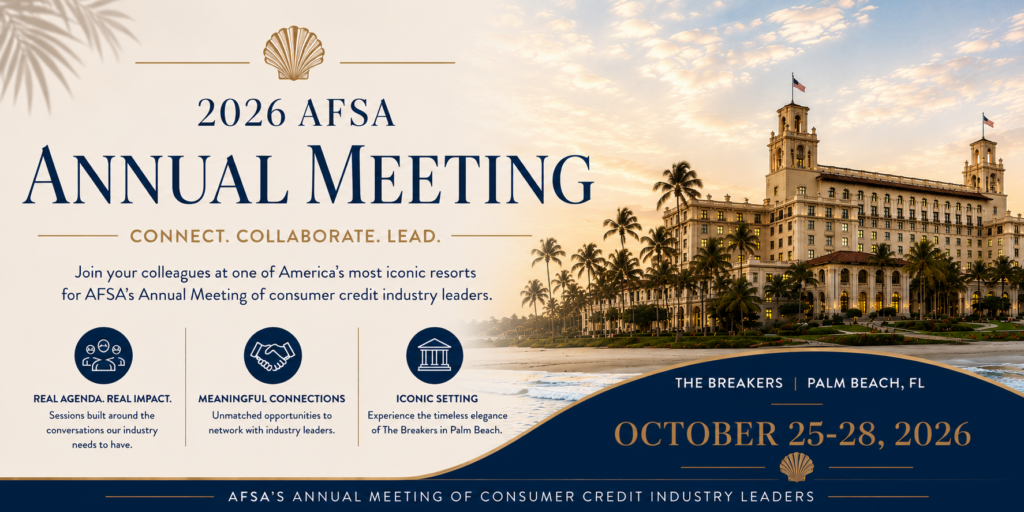
Registration is OPEN for the 2026 AFSA Annual Meeting
Jun 02, 2026
Reading the Room: What Voters Are Really Saying About the Economy and the Road to the Midterms
Numbers don’t lie. But they do require interpretation and AFSA’s Annual Meeting has two of the best in the business to help us do just that.
Two… Read the rest
Well-Intentioned, but Not Well-Executed
May 28, 2026
AFSA has submitted a comment letter raising concerns with SB 3777, noting that while well-intentioned, the bill relies on a disparate impact framework that could create significant unintended consequences for the consumer credit system.… Read the rest