 AFSA is pleased to welcome Charlie Gasparino, Senior Correspondent with Fox Business News and one of America’s most storied business reporters, as the opening keynote speaker for the LIVE 2021 Independents Conference & Expo.
As news breaks and headline stories unfold on Wall Street, Charlie Gasparino helps audiences understand how economic, financial, and political developments impact business growth.
As senior correspondent at FOX Business Network, Charlie delivers expert on-air reporting throughout the business day, covering the latest news from the financial world. An award-winning investigative journalist, he has also served as a CNBC on-air editor, where he broke some of the biggest stories during the financial crisis, including the first reports of AIG’s government bailout, the Lehman Brothers collapse, and the Merrill Lynch and Morgan Stanley shakeups.
Charlie also brings deep experience in print media; he is a former senior writer at Newsweek, where he broke major stories involving Wall Street and corporate America. During his time as a writer for The Wall Street Journal, his work was submitted for a Pulitzer in beat reporting in 2002 and won the New York Press Club award for best continuing coverage of the Wall Street research scandal. He has written several financial best-sellers, including The Sellout and Blood on the Street, and served as a contributor to the Daily Beast, New York Magazine, and Forbes.
Drawing on his extensive background of experience and in-depth knowledge of the inner workings of finance and politics, Charlie shares a thorough analysis of the days’ headlines and illuminates the impact of current and future Wall Street conditions on business.
Still not convinced you need to be there? Take a look at what we’re planning on the Gold Coast and visit independents.afsaonline.org to register today!
Keynote Announcement | Charlie Gasparino Joins AFSA on the Gold Coast
Mar 17, 2021
AFSA is pleased to welcome Charlie Gasparino, Senior Correspondent with Fox Business News and one of America’s most storied business reporters, as the opening keynote speaker for the LIVE 2021 Independents Conference & Expo.
As… Read the rest
Discussing All Sides of Industrial Loan Companies
Mar 16, 2021
Washington, D.C. may be operating under one political party at both ends of Pennsylvania Avenue, but that doesn’t mean only one side of public policy should be discussed.
Unfortunately, that’s exactly what happened on March 12, when the Bank… Read the rest
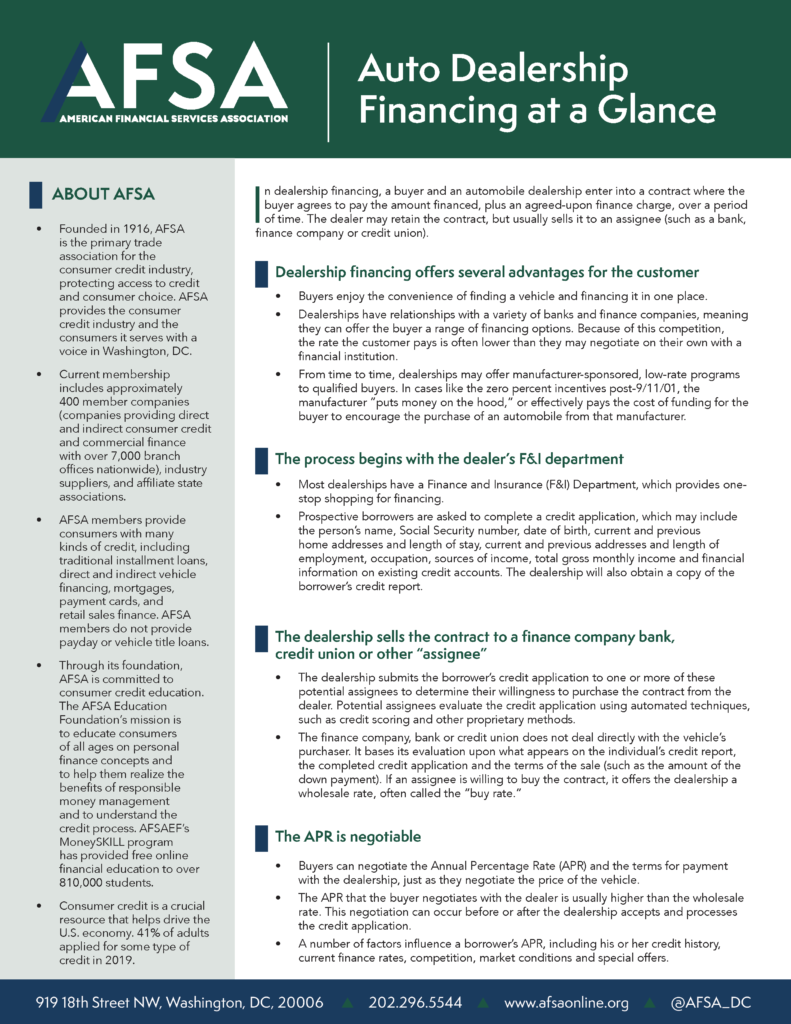
Auto Dealership Financing at a Glance
Mar 15, 2021
Telling Half the Story
Mar 12, 2021
An article in the Bay St. Banner takes a page torn straight from the consumer “advocate” playbook: telling half of the story.
The article details various legislative efforts around the country to implement restrictive, anti-consumer interest-rate… Read the rest
Congress Reaches Agreement to Extend PPP
Mar 11, 2021
Leaders in both parties of Congress reached an agreement to extend the Paycheck Protection Program (PPP) for an additional two months. House Small Business Chair Nydia Velazquez (D-NY) and Ranking Member Blaine Luetkemeyer (R-MO) came … Read the rest
AFSA Supports Fair Debt Collection Practices for Servicemembers Act
Mar 11, 2021
AFSA strongly supports H.R. 1491, the “Fair Debt Collection Practices for Servicemembers Act,” and wrote urging the House of Representatives to pass this legislation as quickly as possible.
The Fair Debt Collection Practices for Servicemembers… Read the rest
AFSA Submits Amicus Brief in Credit Reporting Case
Mar 05, 2021
The American Financial Services Association (AFSA) submitted an amicus brief on March 4 before the United States Court of Appeals for the First Circuit in Consumer Data Industry Association (CDIA) v. Frey. The case was brought by CDIA against… Read the rest
Vehicle Finance Conference Session Recordings Now Available
Mar 04, 2021
If you attended the 2021 Vehicle Finance Conference last week, we are pleased to inform you that recordings of all sessions are now available at the AFSA Streaming Center.
- Click this link to visit the Streaming Center, part of AFSA’s
AFSA Joins Trade Associations Requesting Extension of the PPP
Mar 04, 2021
The American Financial Services Association (AFSA) and fellow trade associations wrote to Congressional leaders supporting the extension of the Paycheck Protection Program (PPP). The loan program, scheduled to end on March 31, originated… Read the rest