
Economic Growth Rebounds in Q2 While the Fed Remains on Hold
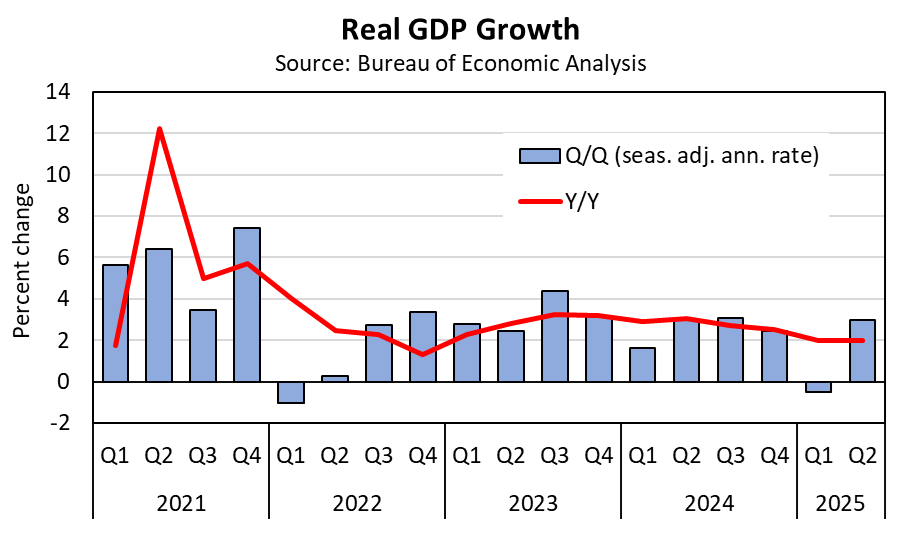
The Bureau of Economic Analysis (BEA) issued its advance estimate of real GDP growth for the second quarter of 2025 on July 30th. The BEA reported real GDP increased at a seasonally adjusted annual rate (SAAR) of 3 percent in Q2, a sharp turnaround from the drop of -0.5% recorded in Q1. Although GDP surpassed expectations, it did not necessarily tamp down concerns over the health of the economy.
The large swing in real GDP growth in the first half of the year was largely driven by simmering international trade tensions. The combined impact on topline real GDP growth from changes in net exports and inventory investment, both of which have been heavily impacted by tariffs (both proposed and implemented) shifted from a 2- percentage point headwind in Q1 to a 1.8-percent tailwind in Q2.
Meanwhile, consumer spending growth accelerated in Q2, but was somewhat tepid by historical standards at 1.4 percent SAAR. Growth in business investment outlays, meanwhile, dropped from 10.3 percent SAAR in Q1 to 1.9 percent SAAR in Q2.
Despite worries over tariff-driven inflation, the price index for core consumer spending increased 2.5 percent SAAR in Q2, down from 3.5 percent SAAR in Q1. This represented a significant move toward the Federal Reserve’s inflation target.
Separately the Federal Reserve, as was widely expected, announced that it would hold the federal funds rate target range steady at between 4.25 percent and 4.5 percent, where it has remained since January. Although the decision was widely expected, it was unusual that the vote of the 12-member Federal Open Market Committee, the Fed’s interest rate policy body, drew two dissents.
Fed Governors Bowman and Waller were both previously on the record as favoring a faster pace of rate cuts than Fed Chair Powell and a majority of the committee has so far agreed to. It was the first time in more than 30 years that two governors, as distinct from the regional Fed bank presidents who cycle through the committee, bucked the majority.
In his press conference following the announcement of the rate decision, Powell maintained the FOMC would remain focused on incoming data as it considered future rate decisions. In the wake of the meeting, financial markets bets were tilting toward a rate cut of 25 basis points at the Fed’s next meeting in mid-September and placed a 67 percent probability of a cumulative 50-basis points of rate reduction by the end of the year, according to CME Fed Watch.
July 30th, 2025
Get The News You Need
Sign up for our daily newsletter to receive all the most important industry news and updates every weekday morning.
Recent Posts
- SGA’s Letter on Colorado Automated Decision-Making Technology Act
- Long-Term Interest Rates on the Rise
- IRS Issues Car Loan Interest Regs
- September White Paper | Disparate Impact
- AFSA on “For-Profiteer” Debt Settlement